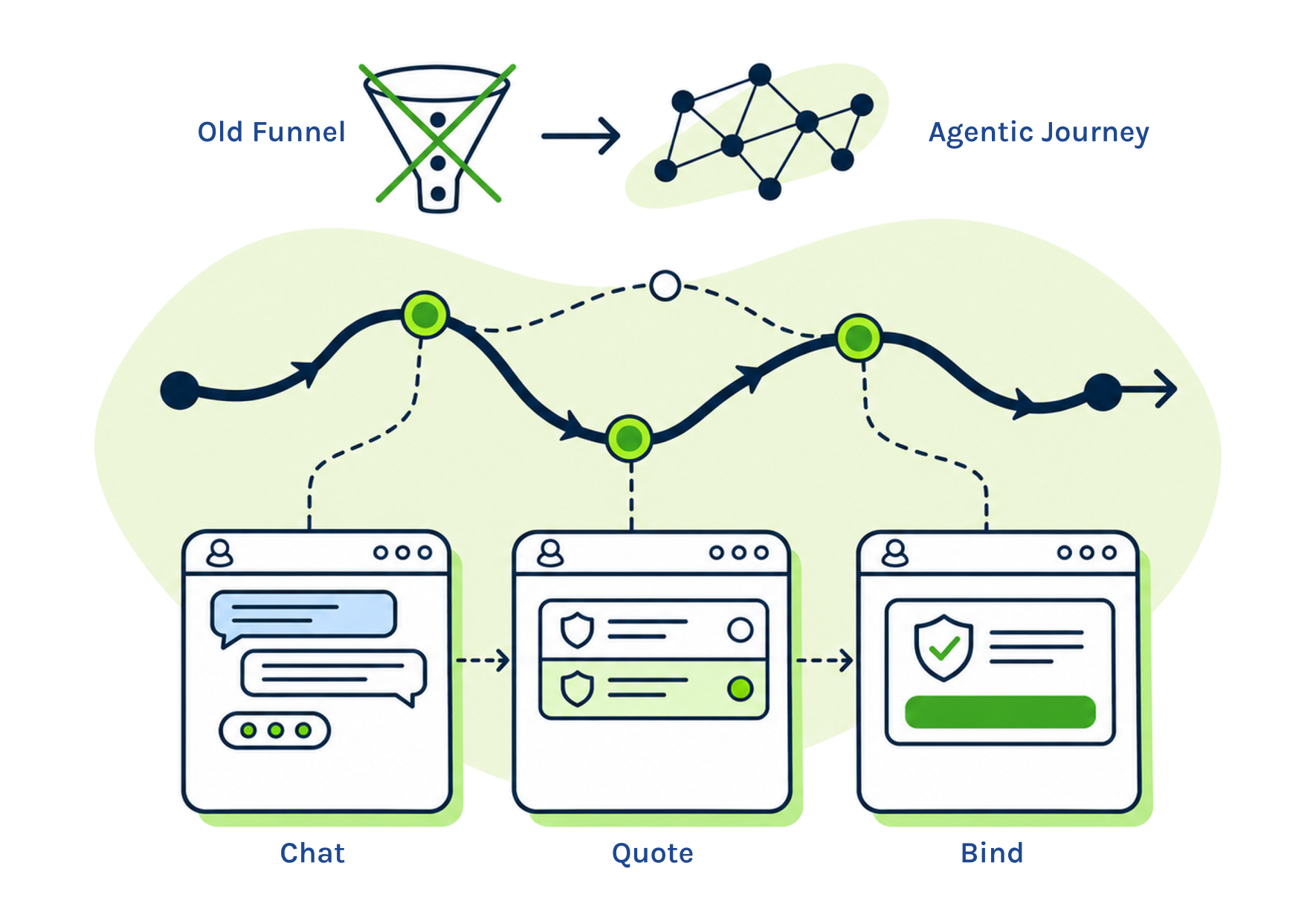
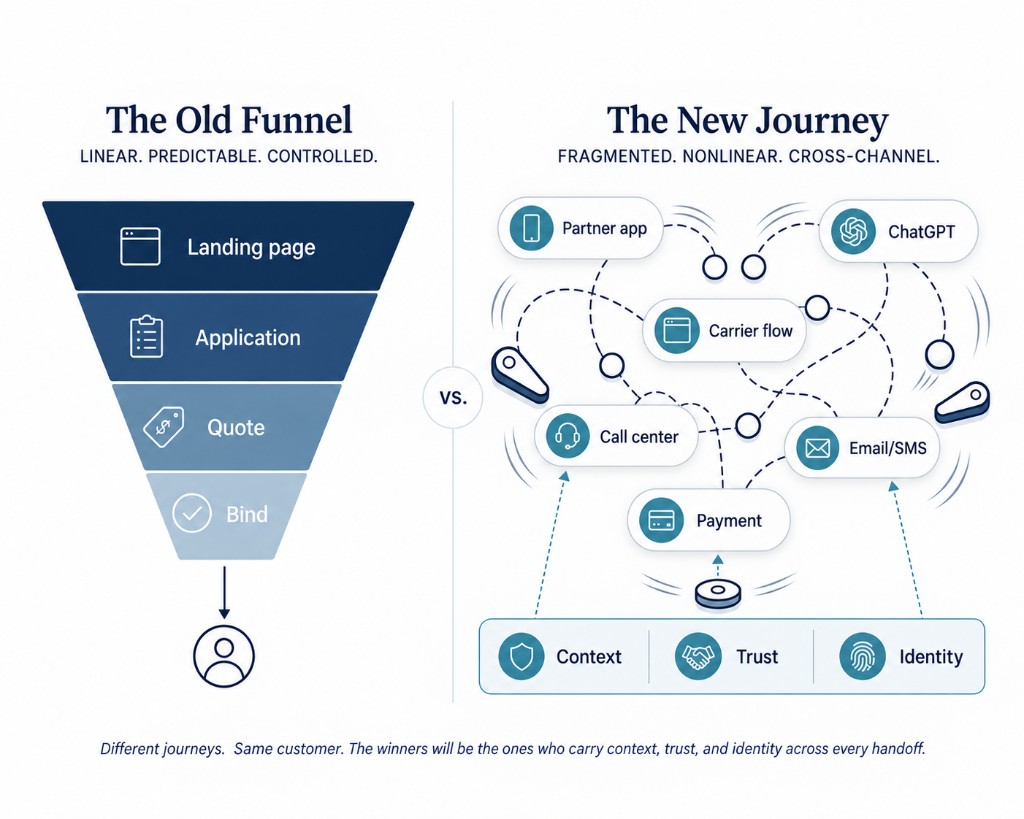
AEO is not SEO with a new hat. It is distribution for answer engines.
The ranking page is becoming the answer. For insurers, being findable is no longer enough. Your product has to be understandable, comparable, and ready to act on.
A lot of AEO advice is SEO advice with a new acronym taped to the front.
Write more FAQs. Add long-tail keywords. Publish a few opinion pieces about AI. Watch your traffic. Hope the answer engine notices.
That is not enough for insurance.
Answer engine optimization is not just about appearing in a generated answer. It is about making your product and your transaction legible to the systems deciding what to recommend, how to describe it, and whether the user can actually move forward.
The difference sounds subtle until you realize that the customer may never see your homepage. They may see a summary, a comparison, a recommendation, a quote card, or an app invocation inside an interface controlled by somebody else.
The page is no longer the unit of distribution
The old web gave marketing teams a familiar sequence: search result, landing page, form, nurture, conversion. The answer engine compresses the first half of that sequence. The assistant can interpret intent, summarize options, and decide which products deserve to be shown before the customer ever reaches a carrier domain.
OpenAI’s Instant Checkout launch makes the direction explicit. ChatGPT can show products, pass information to a merchant’s backend, and support purchase without sending the customer through the traditional website journey. Target’s own rollout now spans ChatGPT, Gemini, and Copilot, with more of the shopping journey happening inside conversational surfaces.
The distribution surface is changing before most insurance teams have decided what their answer-engine presence should even contain.
AEO has three jobs
The first job is findability. Can the system discover the product? That sounds easy until the product is not a single SKU. Insurance may vary by state, age, risk, coverage limit, deductible, underwriting result, partner, and channel. The answer engine needs enough structure to understand what is actually available.
The second job is representation. Can the system describe the product without flattening the important parts? This is where brand, exclusions, eligibility, price ranges, disclosures, and coverage language matter. If the model cannot tell the difference between a benefit and a guarantee, you have a representation problem, not a copy problem.
The third job is actionability. Can the customer do something useful after the answer? Compare. Get a quote. Continue on web. Talk to a licensed person. Bind with explicit consent. An answer that generates interest but cannot carry the next step is still a dead end.
Profound’s AEO platform is useful here because it treats AI visibility as something to measure: presence in answers, citations, share of voice, prompt demand, and crawler behavior. That is a better starting point than pretending that a single rank position explains the new funnel.
The retailers are already teaching us the pattern
Adobe’s data shows that generative AI traffic to US retail websites has grown dramatically, and those visitors often arrive more engaged than visitors from traditional sources. Walmart is building an AI shopping companion around search, review synthesis, comparison, recommendations, and eventually repeat tasks. Target is expanding across several assistant surfaces rather than betting on one new homepage.
The pattern is not just ‘put your catalog in ChatGPT.’ It is: make the catalog machine-readable, make the rules explicit, make the transaction reachable, and make the brand recognizable even when a model is doing the explaining.
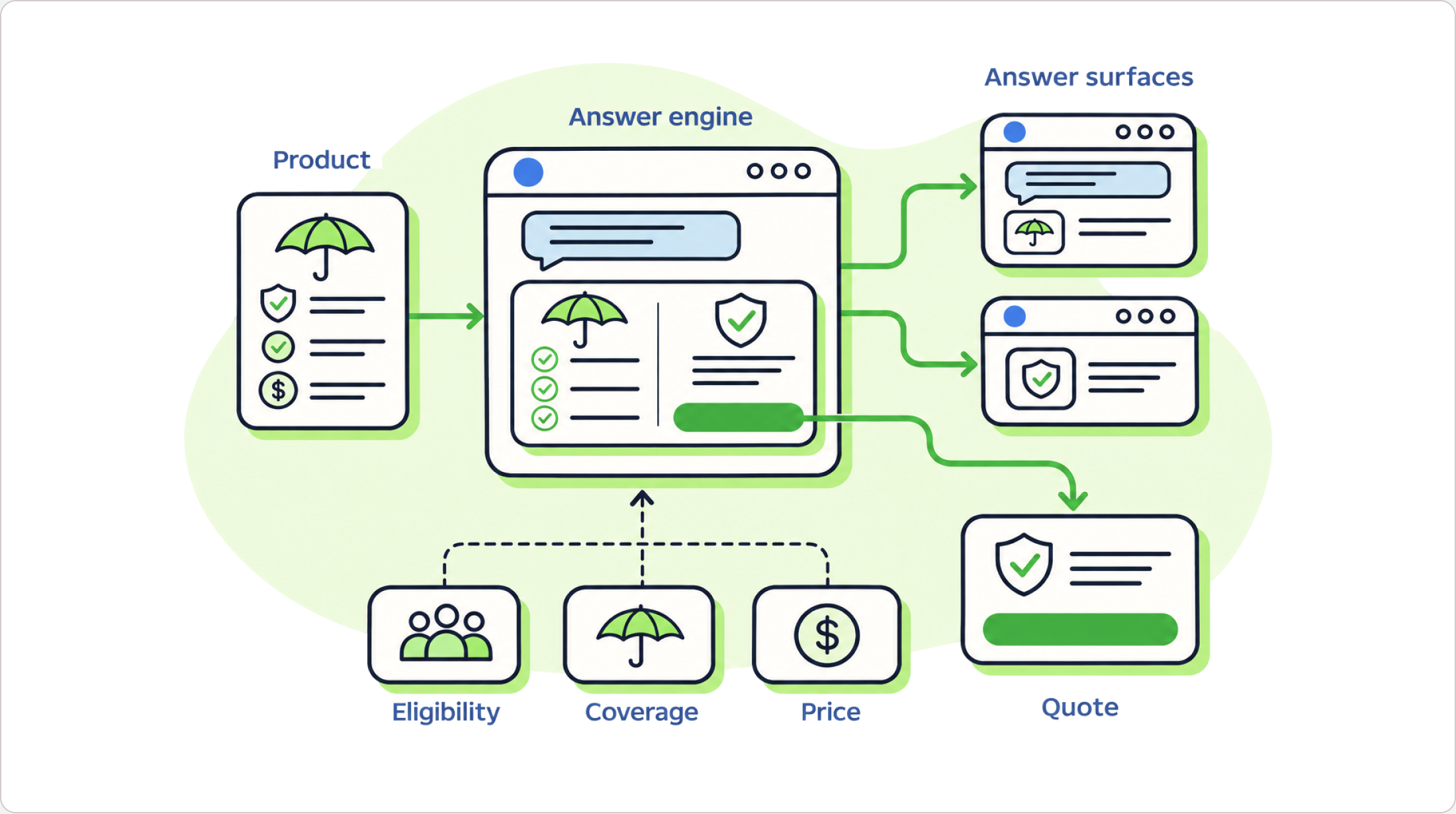
Insurance has to apply the same logic to a more complicated object. A carrier cannot optimize only the sentence that describes the policy. It has to optimize the product object, the quote logic, the disclosure package, the payment and bind path, and the handoff rules behind the answer.
Fletch’s first transaction is the proof point
In October 2025, Fletch completed what Insurance Innovation Reporter described as the first known insurance policy purchase executed entirely by an agentic AI system in a controlled production environment. That is the difference between being mentioned by an AI system and being ready for an AI-mediated transaction.
The transaction required more than a polished answer. It required an agent to help guide coverage choices, a payment layer that could tokenize credentials, configurable disclosures and consent, and licensed producer oversight. The work was not only to make Fletch discoverable. It was to make the entire path usable and accountable.
That is where Fletch’s AI infrastructure is aimed: controlling product availability, presentation, compliance logic, human routing, journey continuity, and attribution across AI and non-AI surfaces.
What a carrier should make legible
If you want an agent to represent your product well, give it something better than a brochure and a pile of PDFs.
Make the following explicit: who is eligible, where the product is available, what it covers, what it does not cover, how price is determined, what information is required, when disclosures must appear, what requires a human, what can happen inside chat, and what must move to a secure or licensed surface.
Then measure what happens after the answer. Which assistants surface the product? Which prompts create qualified journeys? Which descriptions lead to quote requests? Which paths finish on web, in chat, or with an agent? Where do consumers ask for help? Where do they drop?
This is not SEO with a new hat. It is a new distribution layer with a messy, consequential back end.
The carriers that treat AEO as a content exercise will get impressions. The carriers that treat it as product and transaction infrastructure will get a chance to win.
Sources
The links below are the external references used in this article. Fletch-specific claims are identified as first-party or trade-press sources.
- The Complete AEO Platform - Profound; 2026
- Buy it in ChatGPT: Instant Checkout and the Agentic Commerce Protocol - OpenAI; 2025
- Generative AI-powered shopping rises with traffic to retail sites - Adobe; August 2025
- Inside Walmart’s strategy for building an agentic future - Walmart; May 2025
- How Target is shaping shopping experiences in conversational AI - Target; June 2026
- Fletch enables first agentic AI insurance policy purchase - Insurance Innovation Reporter; October 2025
- Agentic Commerce - Fletch; 2026
- Agentic commerce: Make your brand unmissable - Accenture; April 2026
- Agentic Commerce in Insurance: Meeting Customers Where They Search - Insurtech Insights panel recap; 2026