Trust is the conversion rate nobody is measuring yet.
Agentic commerce will not scale because agents can move faster. It will scale when people believe the agent understood them, stayed within its authority, and left them protected when something goes wrong.
The industry is going to spend a lot of time measuring agentic commerce with familiar metrics.
Impressions. Quotes served. Completion rate. Average bind time. Premium. Cost per acquisition.
Those are useful. They are not enough.
When an AI system is helping a person choose insurance and move money, the conversion event carries a different question: did the customer understand what happened, and will they still feel protected when the transaction is tested by reality?
That is trust. It is not a soft brand metric. It is a hard constraint on whether the market can move from demos to repeat behavior.
The customer is interested. The customer is not naïve.
The Mills Review found real appetite for more automated financial journeys. One in five respondents were open to AI acting autonomously within preset goals. But the same research found serious concerns: data misuse, lack of protection, concentration of power, and uncertainty about who is responsible when something goes wrong.
That combination matters. People want the convenience. They do not want to discover later that convenience meant they surrendered control without understanding it.
The FCA’s research also points to a trust gap between explanation and responsibility. People may believe AI can explain something clearly while remaining skeptical that it will avoid misleading them or handle their personal information responsibly. A good answer is not the same as a safe outcome.
Visa’s consumer research lands in the same place: most consumers want transparency into how agents make decisions, and many would stop using the experience if control disappeared.
Trust lives inside the flow
This is where agentic insurance gets more interesting than generic AI shopping.
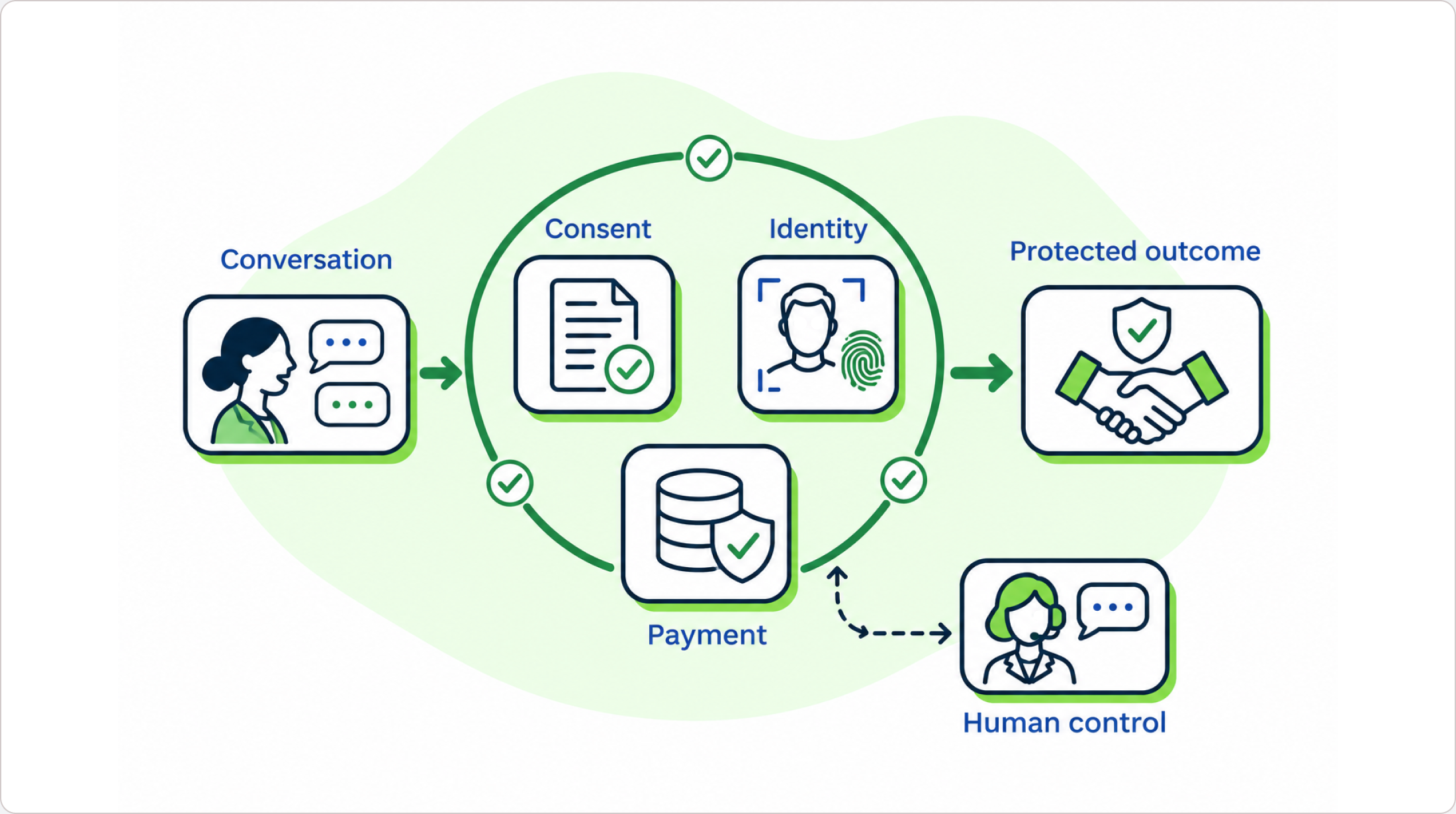
A consumer does not need to approve every internal lookup. They do need to know what is being purchased, for how much, with what coverage, under what terms, and with what recourse. They need clear moments of authorization. They need a record of what was shown. They need a way to challenge the result.
The control point should not feel like a punishment. It should feel like the part of the flow that makes the rest of the flow trustworthy.
That means making consent visible at the right moment, keeping payment authorization scoped, verifying identity when it matters, and preserving the context required for a dispute or human review. Mastercard’s Agent Pay work frames the same issue through payment infrastructure: agents need to be identifiable, governed, and traceable.
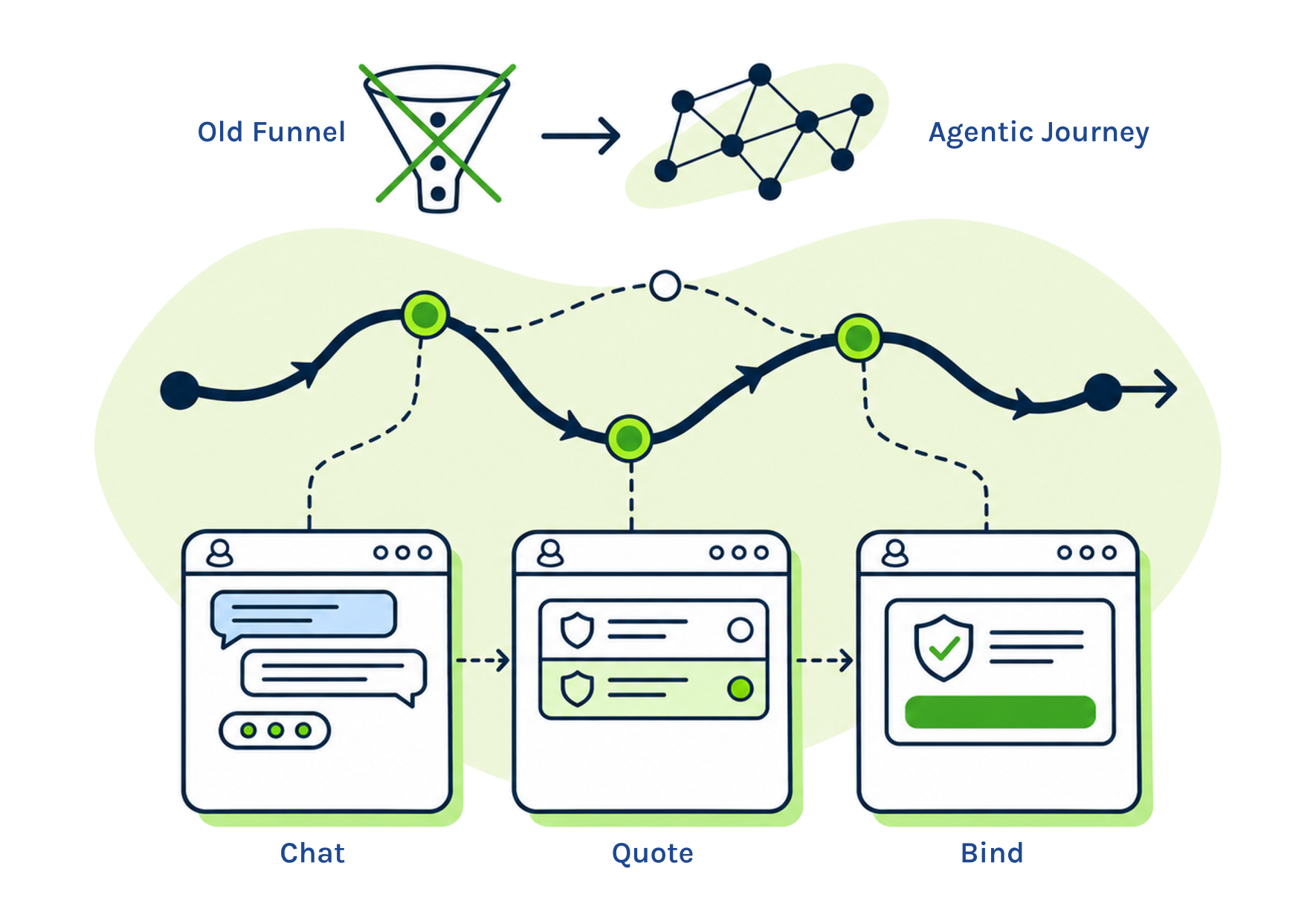
Trust is not a modal that appears at the end of checkout. It is a property of the whole journey.
Fletch’s first transaction was a trust exercise
In October 2025, Fletch completed what Insurance Innovation Reporter described as the first known insurance policy purchase executed entirely by an agentic AI system in a controlled production environment.
The transaction matters because of the controls around it. It was completed with consumer consent under the supervision of a licensed insurance producer. Stripe tokenized the payment credentials. The system used configurable disclosures. The transaction was not presented as a free-for-all where the model could improvise its way to a policy.
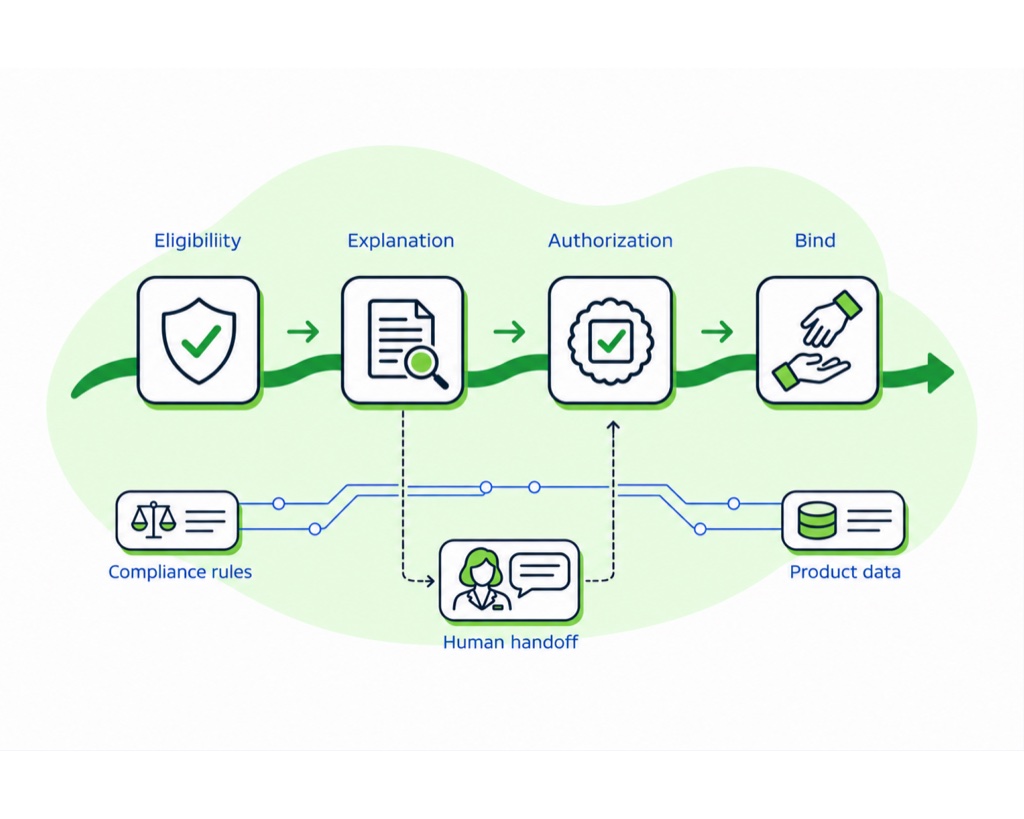
That is the pattern carriers should copy. Let the system move quickly where the risk is low and the customer’s intent is clear. Add a visible control point when money moves. Escalate when the product, the situation, or the consumer’s question requires a human. Keep an auditable trail all the way through.
The Fletch platform treats compliance logic, human routing, journey continuity, and attribution as part of the same configurable layer. That is important because trust breaks at handoffs just as easily as it breaks at payment.
Measure confidence, not just speed
The next agentic dashboard should not stop at conversion rate. It should also show how the transaction earned confidence.
Track whether the customer saw the required disclosure. Whether the user confirmed the right product. Whether the agent stayed within the authorized scope. Whether a human had enough context to handle an escalation. Whether the customer returned to ask what they actually bought. Whether a complaint or cancellation followed a fast bind.
The language here matters. A completed transaction is not automatically a good transaction. A faster bind can hide a worse outcome if the customer did not understand the coverage or had to start from scratch when they needed help.
This is why ‘responsible conversion’ is a better north star than raw conversion. It keeps growth and consumer protection in the same sentence.
The market will move at the speed of trust
The payment networks are building the rails. The retailers are building the interfaces. The models are getting better at carrying context and making decisions. The remaining question is whether consumers believe the system will act in their interests when the answer is not obvious.
Insurance has an advantage here if it uses it well. The category already understands disclosures, licensing, consent, records, and redress. Those are not obstacles to agentic commerce. They are the building blocks that make it credible.
The fastest company will get attention. The company that can explain, authorize, bind, and stand behind the transaction will get repeat business.
Sources
The links below are the external references used in this article. Fletch-specific claims are identified as first-party or trade-press sources.
- Insurance Topics: Producer Licensing - NAIC; 2026
- The Mills Review: AI and the future of retail financial services - FCA; 2025
- Earning Consumer Trust in Agentic Commerce - Visa; 2026
- Mastercard Agent Pay - Mastercard; 2025
- Fletch enables first agentic AI insurance policy purchase - Insurance Innovation Reporter; October 2025
- Agentic Commerce - Fletch; 2026
- Agentic commerce: Make your brand unmissable - Accenture; April 2026
- The Mills Review press announcement - FCA; 2025
- Agentic Commerce in Insurance: Meeting Customers Where They Search - Insurtech Insights panel recap; 2026