Agentic commerce will not replace insurance agents. It will change what humans are for.
The best agentic journeys will absorb the repetitive work and preserve the moments where judgment, reassurance, licensing, and trust actually matter.
Every conversation about agentic insurance eventually arrives at the same prediction: AI will replace the agent.
It is an understandable fear. Insurance has a lot of repetitive work. Intake. Product explanation. Quote preparation. Follow-up. Data entry. Status updates. The industry has built entire teams around the fact that systems do not share context cleanly.
But replacing every human is the wrong frame.
The more useful question is: which work should disappear, and which work should become more human because the machine handled everything that got in the way?
The coverage gap is partly a follow-through gap
Deloitte’s 2026 research makes the problem clear in life insurance. Many consumers say they need coverage or more of it, but the move from awareness to informed action is still weak. The product is important. The journey is difficult. People postpone it.
That is exactly the kind of work an agent can help with. It can explain the basics, gather the right context, compare options, prefill the next step, remember what the customer already said, and follow up without making the customer repeat the story three times.
The goal is not to make the human irrelevant. It is to stop spending human time on the parts of the journey that software should have handled years ago.
Walmart describes a similar operating model in retail: agents route and resolve more routine work while associates focus on complex tasks. McKinsey’s agentic CX research points toward the same future, where context-preserving handoffs become part of the experience rather than a failure of it.
The human gets the better conversation
A good insurance handoff should not begin with ‘How can I help you today?’ after the customer has already spent ten minutes explaining the situation to an AI assistant.
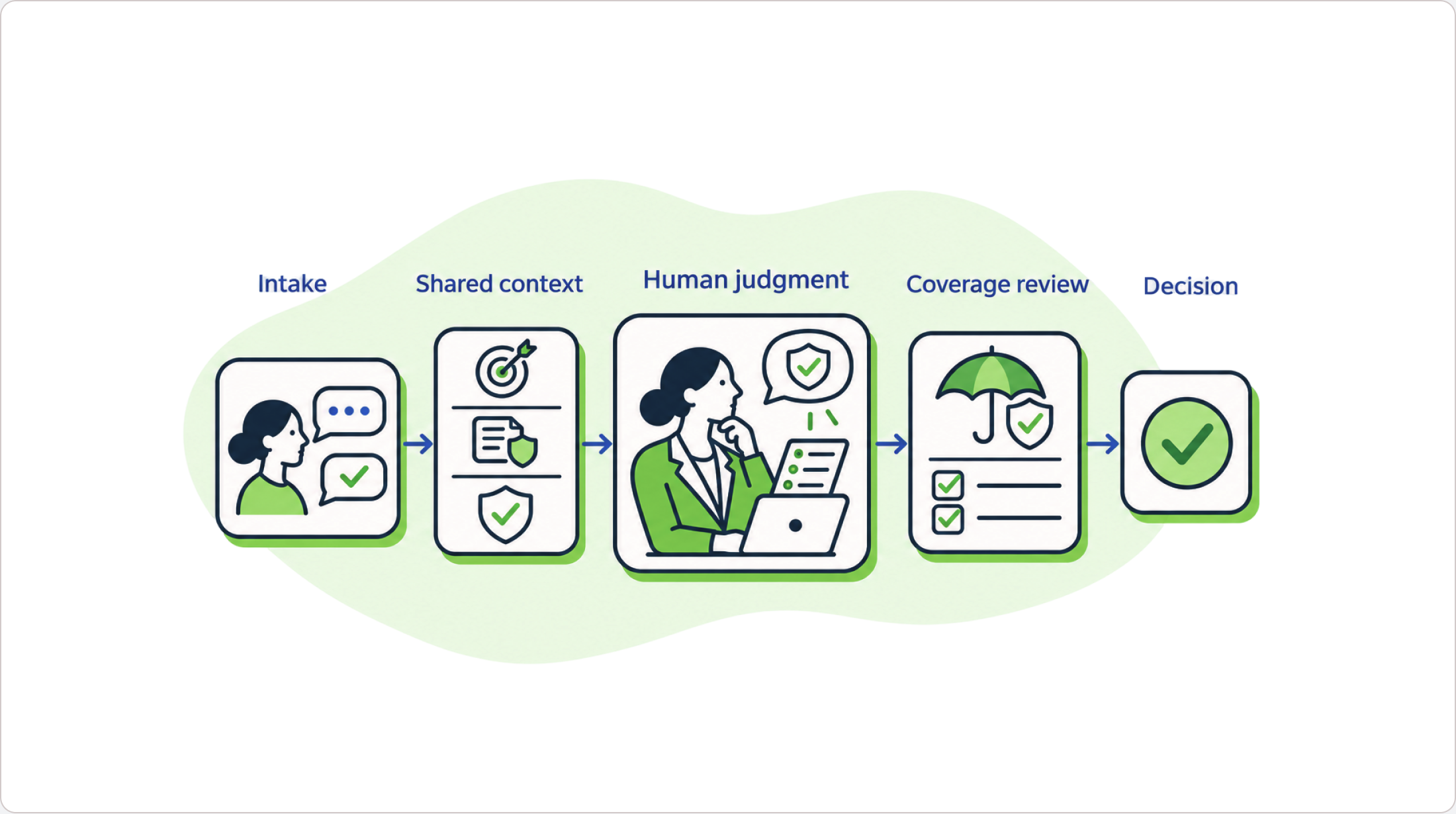
The licensed agent should receive the quote or policy context, the customer’s stated goal, the options already reviewed, the disclosures shown, the consent state, the payment status, and the question that caused the handoff. That changes the job from reconstructing the past to helping with the decision that still needs judgment.
This is especially important when the customer is anxious, the coverage is complicated, the risk is unusual, or the consequences of getting it wrong are material. Those are not defects in the human model. They are the moments where a human model earns its keep.
At Insurtech Insights NYC, Fletch brought Stripe, Profound, USAA, and Faye Travel Insurance together to talk about where AI-mediated discovery meets insurance’s trust and compliance requirements. One point kept resurfacing: consumers will choose different endpoints. Some will bind in chat. Some will continue on web. Some will want a person.
The winning infrastructure will let them choose without forcing the business to start over.
Fletch has already made the handoff real
In October 2025, Fletch completed what Insurance Innovation Reporter described as the first known insurance policy purchase executed entirely by an agentic AI system in a controlled production environment.
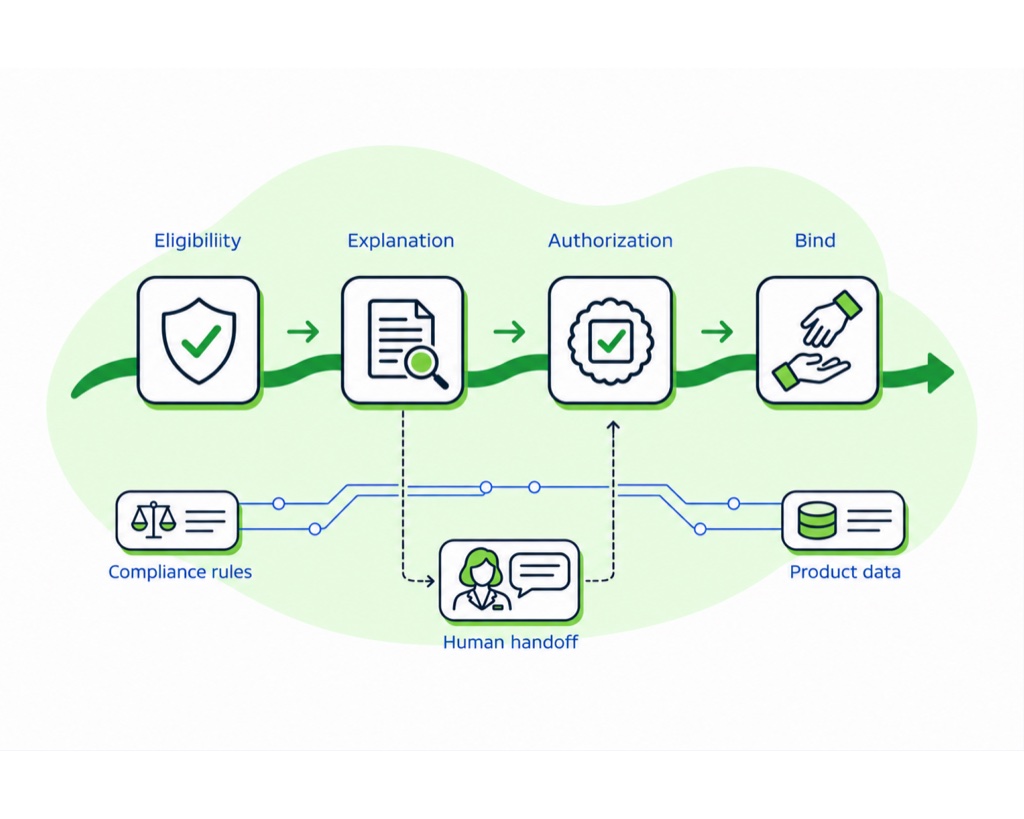
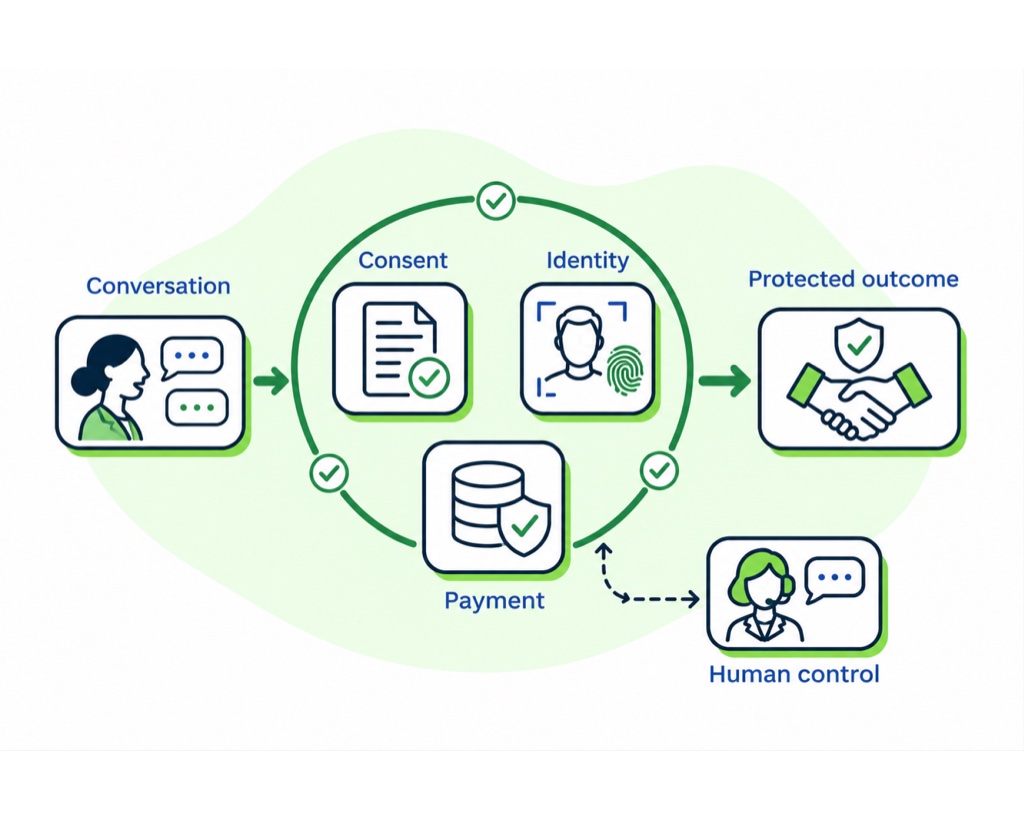
That transaction is often described as an AI purchase. The more interesting description is an accountable handoff system. The customer could move through coverage choices, payment, and bind with consent. The system retained context. Stripe handled tokenized payment credentials. A licensed producer supervised the transaction.
That is a model for how the work changes. The agent handles speed and continuity. The regulated human remains available when judgment or reassurance is needed.
The Fletch AI platform makes that configurable: bind in chat, continue on web, or route to a licensed agent while keeping context intact across the surfaces.
What humans should stop doing
Humans should stop acting as the glue between systems that refuse to talk to each other. They should stop retyping information a customer already provided. They should stop spending valuable time answering questions that a well-structured product explanation could handle. They should stop chasing every low-intent lead because no system can tell a real need from a vague click.
That work creates delay, cost, and frustration. It also makes the human interaction feel less valuable because the customer reaches a person only after the system has already wasted their time.
What humans should do more of
Humans should handle ambiguity. Edge cases. Sensitive life events. Complex risk. Coverage questions where the answer depends on facts the customer has not yet articulated. Situations where the customer is not asking for more information; they are asking whether they can trust the decision.
They should also own exception management. When an agent cannot complete a transaction, the handoff should be deliberate, not a dead end. The human should know what happened, why it stopped, and what the customer expected to happen next.
This is not a consolation prize for the human workforce. It is a better allocation of expertise.
The future agent is better prepared
The best outcome is not an autonomous system that never needs a person. It is a customer who reaches the person at the right moment with the right context already attached.
That is how agentic commerce can help close protection gaps instead of widening them. It can make the first step easier, the comparison clearer, and the handoff more useful. It can let a licensed human spend time on the decision rather than on reconstructing the journey.
Insurance agents are not going away. The pointless parts of their job should.
Sources
The links below are the external references used in this article. Fletch-specific claims are identified as first-party or trade-press sources.
- Agentic AI could help US life insurers reach new customers and narrow the coverage gap - Deloitte; May 2026
- Rewiring customer experience for the agentic era - McKinsey; 2025
- Inside Walmart’s strategy for building an agentic future - Walmart; May 2025
- Fletch enables first agentic AI insurance policy purchase - Insurance Innovation Reporter; October 2025
- Agentic Commerce - Fletch; 2026
- The Mills Review: AI and the future of retail financial services - FCA; 2025
- Agentic Commerce in Insurance: Meeting Customers Where They Search - Insurtech Insights panel recap; 2026
- Agentic AI and insurance companies - Accenture; October 2025